Monday, 8 March 2010


Sunday, 7 March 2010
Robin Schwartz - Amelia 's World: Animal Affinity


'My photographs are drawn from real journeys undertaken with my daughter, Amelia. I am driven to depict relationships with animals but the photographs are not documents; they are evidence of the invented worlds that we explore and the fables we enact together. Photography gives us the opportunity to access our dreams, to discover the extraordinary.
Animals and interspecies relationships have always been an important part of my work. The animals in my photographs are not represented as beasts or nobility but as part of our everyday world. My first monograph, a series of primates at home with humans, guided me to the places of my own childhood fantasies.
I photograph myself with animals through Amelia. I am an only child who has an only child. Each of us has a strong fantasy world. Amelia and I play out our eccentricities in worlds where she and animals not only co-exist, but also interact. Animals are not props in my photographs and they are not photo-shopped in. The world that my daughter and I explore is one where the line between human and animal overlaps or is blurred.
Amelia and I both a strong connection to animals, but we are very different. I have always been obsessed with animals, having a necessity their company, driven to have animals in all aspects of my life and work. I work at my relationship to animals. Amelia is not driven or obsessed in my way, she is not self conscientious with animals as I am. Amelia has a remarkable comfort level with animals and they with her. Amelia is oblivious that this is a usual gift.
An artist photographing her child can invite ridicule, but getting personal with my projects has always been both my need and my edge. The Amelia’s World project has evolved with my daughter’s maturing personality and aptitude. Amelia is my priority, my muse, my co-conspirator, my tormentor and my bliss. Collaborating with Amelia, I am able to go to any place in time.'

Saturday, 13 February 2010
My Newspaper by Ivars Gravlejs
Continuing with the theme of Photo-manipulation, I recently came across the work of Ivars Gravlejs.
Everyday from photo editors and journalists I got several assignments to photograph events around Prague. Before sending photographs to the newspaper's Photobank I quickly manipulated them in Photoshop. Originally idea was to change some little, unimportant details where the manipulation wouldn't change much the content of the photograph, for example, adding some more buttons on writer's Zdenek Mahler T-shirt or painting inscription - „Cunt“ on the brick wall. Although during the process it happened to make some more radical ones, for example, creating a traffic jam on the highway or cutting of singer's José Carreras finger. The aim of this project was to make an absurd, nonsense manipulation over the media manipulations.' Ivars Gravlejs


'This manipulation I did in a few minutes - I erased a hand of another singer and Carrera's finger, because in a photojournalism "the cut off a hand" is a mistake.'


'Here on the foreigners T-shirt I wrote "SMRT" (DEATH). It's my message to police.'


'On the 31st of August I had to photograph the traffic jam. I came to the place, but there was no jam. To get the picture I had a possiblity to throw a brick on the highway or to choose the less painful way - to go home and make the photo in peace. (The most crucial issues for the newspaper "Denik" are traffic jams, dirty streets and parks, homeless, foreigners and the weather.)'
'Gravlejs project is a typical example of so called „Subversive Art“. Art which is parasitic on the concrete subject and affects this subject (in this case media society), undermines and criticizes it. On the one hand Ivars Gravlejs deconstructs authority of medial business, deconstructs authenticity and objectivity of information (in any way medialized and interpreted), but on the other hand Gravlejs contemplates about circumstances of contemporary artist, who often has to suspend his/her creative process in order to earn money for living. Gravlejs carefully „smuggled“ his art in his everyday „Non-Art“ activity.' Milan Mikuláštík
Airbrushing
A few years ago I had heard rumours that a certain film had spent an obscene amount (apparently millions) on having to clean up images of Keira Knightley post filming as there were apparently issue with her skin complection. Recently I stumbled across Charles Arthur's brilliant 'How we Learned to Love Photoshop' article which had an example of a Keria Knightley before and after.
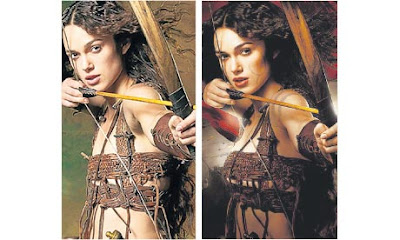


Recently I have been more and more aware of an increasing number of Photoshop/airbrushing related articles in the mainstream media. In The Word magazine earlier this year I saw a great article that I've been trying to get my hands on by Andrew Harrison which showed some fantastic examples of airbrushing.
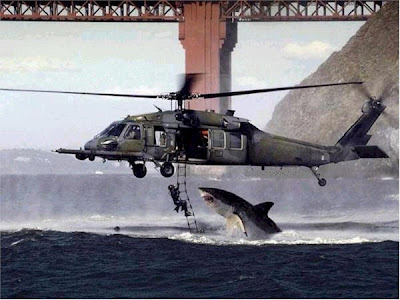
One image which is particularly memorable that I have managed to retrieve from Google is the image of a shark attacking a military helicopter which was released in August 2002. Initially people did believe that the image was real, but it did later transpire that it was infact two seperate images skillfully Photoshopped together.


Charles Arthur enlightens his readers with the history of Photoshop saying, 'Photoshop has, like Google, transcended its origins in the world of computing, and become a verb. But whereas "to Google" is almost always used positively to express usefulness, Photoshopping is almost always a term of abuse: "That picture was Photo shopped" has become a shorthand way of saying it is untrustworthy and misleading...
...But it was Photoshop that made altering images routine. It began circumspectly as a program written by Thomas Knoll, who, in the autumn of 1987, was doing in a PhD in computer vision but for fun wrote a program to display images with grey in them on a black-and-white monitor. Knoll called the program Display, writing it on his Mac Plus computer. Then his brother John, who worked at George Lucas's Industrial Light and Magic company, which did the visual effects for the Star Wars films, noticed its potential. They collaborated, bought a Macintosh II – capable of displaying colours! – and set to work; the program's name mutated until they hit on Photoshop.
In September 1988, Adobe Systems signed a licence to distribute it – wisely, the Knolls took a royalties deal that made them very rich. And on 19 February 1990, Photoshop 1.0 became available. At the time it fitted on to a single floppy disk – nowadays it takes a DVD – although it had, even then, fallen foul of piracy after the Knolls demonstrated it to some Apple engineers, who "shared" the demo disks that were left behind with a few hundred of their closest friends. Nowadays, Photoshop is reckoned to be one of the most pirated programs in the world, behind Microsoft's Windows. Its high price – around £560 – is indicative of the fact it has no real rivals.
Photoshop quickly became embedded in computer culture. Apple would try to prove its computers were faster than those running Windows by holding "Photoshop bake-offs" during Steve Jobs's keynote addresses: a Windows machine and an Apple one would run through an automated process to tweak and manipulate an image in exactly the same way. Oddly enough, the Apple machine always won.
Photoshop has even created its own two-player sport, "layer tennis". The first player "serves" an image: the opponent then alters it and sends it back; the first player continues the process. Done in public, with commentary, it takes on its own strange allure.
Do not, though, expect to join the ranks of elite players immediately. Seeing Photoshop running on a computer is like viewing the cockpit of a 747; what, you wonder, do all those buttons do? Many experts say they have taught themselves how to use it over a decade or more. Creative technology consultant Richard Elen describes it as less like flying a plane, more like dealing with a huge house – some people never visit all the rooms. "I probably use 50%-70% of what the apps can do," Elen says. "There are features I seldom, if ever, use. Others I use all the time – clone tools, for instance [which copy an item inside an image] – and I think I'm fairly adept at them."
Russell Quinn, a computer scientist and self-taught Photoshop user, says it's "akin to picking up a guitar for the first time. The whole world is there for the taking, but it's difficult to get started." He thinks two years is a reasonable timescale to get on top of it.
Steve Caplin, who has done photomontages for the Guardian for 20 years, recalls his first use of the program: "An illustration in Punch of the Queen. Photoshop was very much simpler then, but it had real power." He too has featured on the Photoshop Disasters blog – "A missing shoulder on the cover of my book, ironically called How to Cheat in Photoshop!" – and says he feels real sympathy for those who have run into trouble with the program.
"It's all too easy to overlook something that's then blindingly obvious when it's printed. It's just like spelling mistakes in print, really." ' (Charles Arthur)

There are Blogs out there which cover the good, the bad and the ugly of Photoshopping/airbrushing. Photoshop Disasters in particular does bring a big smile to my face when looking at some of the extreme examples and humorous comments attached, a nice bit of morning viewing to get my day started with a smile!
Thursday, 4 February 2010
Jonny Briggs
Earlier this year I visited the Royal College of Art work in progress show, which showcased work from Textiles, Fine Art Photography and GSMJ. The exhibition is always packed with a multitude of students work and because of this I always find it really difficult to digest and remember the work. However, one month on and Jonny Briggs manipulated photography pieces still remain vivid in my mind.


Tuesday, 2 February 2010
Fakes and Forgeries @ V&A
I couldn't resist revisiting the Decode exhibition at the V&A again yesterday, I really am making the most of my entitlement to free entry. Whilst I was there I popped down to the Fakes and Forgeries exhibition, which showcases some of the fakes that the Metropolitan Police have collected.

It did get me thinking about Art especially in terms of how I was taught Art at a young age. I remember through school students were encouraged to copy great works of art, and by the end of secondary school I had already ripped off Matisse, Mondrianne and Picasso. I recall in my fourth or fifth year at secondary school agonising over a making a replica of a Toulouse Lautrec painting. The results were pretty dismal, hands and feet were never my forte. At the time I blamed it on the poor choice of the schools available materials, acrylic paint rather than opting for the more authentic and more expensive choice of oil paints. Even before secondary school I was copying images, it was mainly images of Garfield and Snoopy, and most of the time they looked like they'd been mowed over by a steamroller or put through an industrial mincer. Had my attempts at Lautrec's dancing girl been more successful my career choice could well have been very different, and I'm sure the forgery trade must be far more lucrative than textile design (which I would like to add I am directing myself away from).
I guess the only difference is between a forgery and what I and many other school children do/have done is that we are not making very convincing pieces of work and trying to call them originals.
It takes great skill to replicate perfectly a great piece of work, a steady and adaptable hand which can replicate a great masters brush stroke and a sharp eye for detail and colour. John Myatt's name/forgeries pops up in the exhibition frequently, which does leave me questioning is he actually a good forgerer if he's been caught?

Top Right - Cello Player in the style of Albert Gleizes (1881-1953), created by convicted criminal John Myatt in the 1990's
Top Middle - Untitled in the style of Mark Gertler (1891-1939), created by convicted criminal John Myatt in the 1990's
Top Right - Balloon Girl in the style of Banksy (active from the late 1980's)
Bottom left - Coins in the style of Iron Age and Anglo-Saxon coins, recovered in the criminal investigation of David Hutchings in 2007.
Bottom Right - King David in the style of Marc Chagall (1887-1985), created by convicted criminal John Myatt in the 1990's.
Monday, 1 February 2010
Pascual Sisto
Pascual Sisto's manipulated videos are amazing!!! I particularly love
'No Strings Attached' and the simplicity of his installation pieces from
the Heavy Hues series are equally powerful and engaging.

G8 - from the series Heavy Hues

Bow - from the series Heavy Hues
No Strings Attached
28 Years in the Implicate Order
No Not Nothing Never
Sunday, 31 January 2010
Make Something Cool Every Day by Brock Davis
This site is brilliant and truly inspiring, in Brock's 'MSCED 09' series he makes a pieces of work every day and posts it onto his website. It's fantastic to see the various media he uses and often humorous narratives that run through the work, and I'm absolutely astounded that he can think up something new every day!!!
I've picked quite a few of his images to post on my blog, but he does have so much more!!!


I've picked quite a few of his images to post on my blog, but he does have so much more!!!


DECODE Digital Design Sensations @ V&A
The V&A have been putting on the most amazing exhibitions. I absolutely loved the recent Telling Tales exhibition and now they've completely blown me away with their current exhibition - DECODE Digital Design Sensations. After 6 years of educational training in textiles design and a further 4 years teaching, I have developed a little obsession with digital media. My specialist areas are Adobe Photoshop and illustrator, but recently I did try to self teach myself a little bit of Flash. I love the idea of pushing the idea of surface decoration further into something that interacts and engages more with the viewer, and this exhibition completely feeds my hunger for these contemporary ideas.
There was so much amazing work that it has taken me quite some time to compile the collected images. And even longer to edit out all the audio of me gasping and wittering on about how incredible it all is to my work colleague in the background of the video footage. I really haven't done it justice or documented the complete collection. IT IS AN EXHIBITION THAT REALLY MUST BE SEEN, and I am definitely going to revisit it.
The work that really took my breath away were...


This amazing piece was created by Sennep and Yoke, it allows the participant to blow away the the seeds on the digital image of the dandelion clock with a hairdryer. I find it so very exciting to see both technical wizardry and gorgeous aesthetics combined and complimenting each other gracefully to create a gorgeous finished product.


James Frost

This piece by Flight 404 was amazing, it the movement of the graphics responded to sound, the picture above the video shows how the graphics appears when it detects no sound.


This piece by Mehmet Atken was absolutely breath taking, it enabled the viewer to create splashes/explosions of colour on the canvas by interacting with the screen.
A brilliant piece by Random International the viewer stands infront of the frame whilst it scans in a temporary image of their face onto the white screen.

Subscribe to:
Posts (Atom)